
My announced topic for the month-long residency that’s coming to an end as I write this in (September 2022) was the utility of analogy for creative thinking about AI and technology regulation. The roots of the topic are in a set of exercises I helped develop for an international workshop on innovative approaches to AI governance a year ago for the Schwartz Reisman Institute for Technology and Society at the University of Toronto and the Rockefeller Foundation.
The workshop was meant to be more than just another convening where participants learned a few new things, networked with important people, and came up with a list of unremarkable principles of AI ethics. To that end, participants were highly curated, a set of concrete projects was developed with “sponsors”- organizations that were committed to moving ahead to implement ideas generated during the workshop, and teams were “seeded” with tentative solution directions so that creative work could be focused from the start. The workshop took place online and the calendar spanned six weeks.
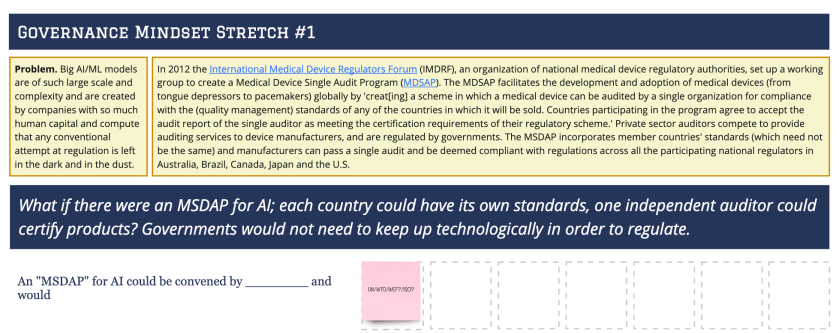
The exercises were called “mindset stretches.” They were part of the ice-breaking and team-building part of the workshop. The goal was to give teams practice working together on topics that were outside most members area of expertise AND to help them form the beginnings of a shared stock of knowledge about regulatory institutions. We used MIRO, an interactive digital white board platform. Here’s what they looked like:

The cognitive work of the exercise is analogical thinking. We introduce participants to two things: an unsolved problem with which they are familiar and an unrelated existing institutional solution to a regulatory problem.
Introducing an existing regulatory solution does two bits of work for us. On the one hand, it enriches participants’ stock of knowledge and it does so as common knowledge – they all know that they all know about this one example of regulatory technology. And on the other hand, the introduction of this existing institution implicitly provokes some abstraction: the AI regulation problem we are talking about is not sui generis; rather it is in a category of problems that humans have encountered, studied, and solved before.
So far, then, we have worked on two preparatory elements: providing team members with shared domain knowledge reference points and coaching participants in the direction of a particular (shared) abstraction.
A third element of “team formation” emerges from the predictable rejection of the premise of the exercise. In almost every case the initial response of smart people to an exercise like this is to point out that the analogy is an inappropriate one. A frequent thinking move is to lightly scan the new information (and combine the scan with presumptions and stereotypes about the new information) and find things that have an ill-fitting analog in the thing they know more about. Artificial joints are physical objects whereas AI is software; there’s really no comparison between the simplicity of a medical device and the complexity of a machine learning model; device manufacturers are already regulated by health agencies and the problem with AI is that nobody knows who is supposed to regulate it.
These objections are intellectually easy and they are what most of us are trained to do – minimize the size of the solution space so as to reduce the cognitive load of considering our options.
And this is even easier to accomplish collaboratively. We had deliberately assembled diverse, interdisciplinary teams. Most members had some connection to AI, but on each team there were usually at least three divergent perspectives being brought to bear on the problem – perhaps an engineer, a lawyer, and an activist. Together they could scan a broad array of properties of the unsolved problem with which they were familiar and find a point of analogy failure with the existing institutional solution. And the better players can pride themselves on identifying a point of analogy failure that no one else would think of.
But this descent into my-own-specialization-which-is-unique-at-this-table is exactly what we were trying to attenuate. Experts can look at the same object and be in completely different worlds as they assess the object’s importance and how they might interact with it. In what feels like a conversation with a shared focus they can talk right past one another, barely hearing what the others have to say. This persistence of silo-ization despite co-presence represents a real impediment to the kind of creative problem solving to which we aspired.
And this is where the playfulness of the pre-workshop exercises becomes important. By presenting this as an icebreaker, a part of our “getting to know one another,” we engage people with a request to “play along with this” that defuses and diffuses the urge to go immediately toward finding fault with the analogy. We lower the stakes and give permission to do a little mental yoga, literally, a mind stretching exercise.
But what of the substance of the exercise itself? Here’s the intended way it works. The team is together in an online session and each has a link to the Miro board we see above. We talk about the activity together, reading over the problem statement, the short description of the existing institution, and the “mad lib” fill-in-the-blanks form. We then give instructions for team members to spend a few minutes “heads down,” that is, working alone, writing onto sticky notes their ideas about what elements of the problem realm might be analogous to the different elements of the existing institution. After a set amount of time we reconvene for “heads together.” For each element of the mad-lib we “go around the room” and ask folks to drag their sticky note to the corresponding square allowing time for discussion about similarities, differences, surprises, etc.

The Power of Stepwise Analogy
The Medical Device Single Audit Program (MDSAP) is a complex global institution with a lot of moving parts. It was hammered out over a number of years by folks with divergent interests but concerned about a shared problem. Its parts and the way they connect together are a product of contextual problem solving that grappled with the gnarly particulars of products, markets, the state of technology, politics, and who knows how much more.
The quick skeptic is right that the MDSAP is not likely to be portable to other contexts. But it represents things a lot of things that were learned and it can provide useful cognitive scaffolding for thinking about other concrete problems in the same abstraction.
Our mad-libs style prompts are drawn directly from the description of the MSDAP. Each element implicitly identifies an element of the solution abstraction. We start with a sense that the effort has to be convened by someone:
An "MSDAP" for AI could be convened by ________
This has participants thinking not about medical devices but AI and who or what entities are institutional players with the capacity for convening at the level of who industries and across national borders. We might start with the particulars of the analog – is there an analog to the International Medical Device Regulators Forum (IMDRF)? Perhaps a participant has an idea but more likely we head off to do some research but, importantly, it’s very directed research. When our team convenes for head-together work we all benefit from the 4 to 6 different directions we went in trying to answer the question. Somewhere in the collision of your take on it and mine I might sense a spark and generate something neither of us had thought of.
Out next tasks play out similarly:
need to include representatives of each country's ___________ .
The analog to, say, FDA, standards would be ________.
Our answers to the first has us exchanging with one another our sense of what agencies in different countries are likely stakeholders in the AI regulation. Again, even if no earth shattering insights emerge, our team is working through shared ideas about a piece of the AI regulation puzzle.
“Devices” in the AI space would be ________.
The private sector auditors could be companies like _______.
The standards that the auditors would have to meet could include things like _______
and be validated by ________.
A solution like this might be piloted on a small scale by _________.

